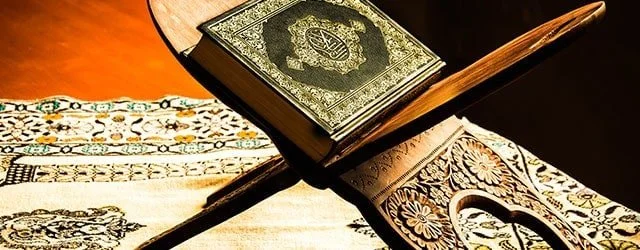
The month of Ramadan in which the Quran was revealed, is a guidance for people with clear proofs and criterion for correct guidance. Whoever sights the month, let him fast it; and whoever is ill or on a journey - then an equal number of other days. Allah intends for you ease and does not intend for you hardship and [wants] for you to complete the period and to glorify Allah for that which He has guided you, and perhaps you will be grateful. (Al-Baqarah 185)
Ramadan is considered one of the most blessed months of the year. This is due to the revelation of the Holy Quran to our beloved Prophet Muhammad, may peace and blessings be upon him. Honoring and showing extreme gratefulness to Allah is done by placing emphasis, priority and focus on reciting, reading, memorizing, reflecting on and implementing the Holy Quran during this month.
Ramadan is also called the month of benevolence and generosity. In Arabic, generosity is الجُود (al-jood) and charity is الصَّدَقة (as-sadaqah). In this article you will learn why Ramadan is the month of generosity, what the Prophet ﷺ did in it, and simple ways to be generous this Ramadan.
Why is Ramadan the month of benevolence?
The clearest answer comes from the Prophet ﷺ himself. Ibn Abbas (may Allah be pleased with him) said: "The Messenger of Allah ﷺ was the most generous of people, and he was most generous in Ramadan when Jibreel (Gabriel) met him. Jibreel used to meet him every night of Ramadan and review the Quran with him. The Messenger of Allah ﷺ was more generous than the blowing wind." (Al-Bukhari and Muslim)
This hadith shows three reasons why generosity grows in Ramadan:
- The Quran: living with the Quran every night fills the heart, and a rich heart gives easily. The Quran is full of verses that call to spending and kindness.
- Good company: the Prophet ﷺ met Jibreel every night. Good company increases goodness, so sit with people who remind you of Allah.
- The blessed time: Allah gives more in Ramadan, so the believer gives more too. Good deeds in this month are rewarded many times over.
"More generous than the blowing wind" means his giving was fast, continuous and reached everyone — the poor, the needy and even the rich — like a wind that brings rain to all the land.
Fasting in Islam
Muslims who are in good health throughout the world are required to fast the entire days of this great month, from the dawn of each day until the sun sets on the same day. It is noteworthy that the holy month of Ramadan is the ninth month of the Hijri year; it comes between the month of Sha'baan (the eighth month) and the month of Shawwal (the tenth month). Read more about the rules and wisdom of fasting in Islam.
Fasting itself teaches generosity. When you feel hunger and thirst from dawn to sunset, you understand the feelings of people who are hungry every day. This is why charity, feeding others and giving iftar are so connected to الصِّيام (as-siyam, fasting).
The benefits of Ramadan
Ramadan has many important and various benefits, which give an opportunity to redeem the soul and gain closeness to Allah at a time most favorable to the seekers of good.
In Ramadan, the acts of worship are doubled. For this reason, it is advisable for all people to take full advantage of doing everything that will bring them an abundance of reward, endless mercy, forgiveness and the elevation of their status with Allah.
The second benefit of this blessed month relates to our health. Many studies suggest that fasting can support the health of the body, for example by helping the body rest and by helping regulate blood sugar and blood pressure. As for the psychological aspect, fasting plays a great role in refining and restraining the human soul by preventing it from the excesses of eating, drinking, sleeping etc, which teaches the mind, body, and soul to control these desires and return to a state of balance.
The third benefit of this great month is that it strengthens and unifies family and community relationships. Ramadan is a time you find people being more concerned about the needs of others. Visiting family members, sharing meals and giving an abundance of charity are some of the greatest most beloved deeds to Allah that we desire to be accepted by Him, particularly in this blessed month.
The reward of charity in Ramadan
The Prophet ﷺ said: "Charity extinguishes sins just as water extinguishes fire." (At-Tirmidhi). He also said: "Whoever gives iftar to a fasting person will have a reward like his, without anything being reduced from the reward of the fasting person." (At-Tirmidhi)
Before the end of Ramadan, every Muslim who is able pays زكاة الفطر (zakat al-fitr), a small charity of food given so that the poor can also be happy on the day of Eid. It is a clear sign that this month is a month of sharing.
Generosity is more than money: 10 ways to be generous in Ramadan
Scholars such as Ibn al-Qayyim explained that generosity has many levels, and not all of them need money. Here is a simple Ramadan checklist:
- Give charity daily, even a small amount. A little that continues is better than a lot once.
- Give iftar to a fasting person — a neighbour, a student or a worker.
- Give your time: help your family prepare iftar, visit a sick person, or help an elderly neighbour.
- Give knowledge: teach someone Surah Al-Fatihah, a short du'a or a word of Arabic. Sharing knowledge is one of the highest kinds of generosity.
- Use your position to help: recommend, connect and make things easier for people who need it.
- Give comfort and sleep: wake up for suhoor with your family, stand in night prayer, and serve others when you are tired.
- Forgive people who hurt you. A forgiving heart is a generous heart.
- Be patient when you are hungry or tired; patience is half of fasting.
- Smile: the Prophet ﷺ said, "Do not belittle any good deed, even meeting your brother with a cheerful face." (Muslim)
- Do not envy what others have; be content with what Allah gave you and thank Him for it.
Generosity is not wastefulness. A generous person spends in the right place and helps where it is really needed, while a wasteful person spends a lot on things that are not needed. In Ramadan, plan your giving so it reaches the people who need it most.
How to make this Ramadan a month of benevolence
- Prepare early in Sha'ban — see how to get ready for Ramadan in Shaban.
- Read a daily portion of the Quran, as the Prophet ﷺ reviewed the Quran every night of Ramadan.
- Choose one person or family to help during the whole month.
- Learn more about the month of Ramadan and how Ramadan is an opportunity to get closer to Allah.
Read and understand the Quran this Ramadan
The secret of the Prophet's ﷺ generosity in Ramadan was the Quran. If you are not a native Arabic speaker, the best gift you can give yourself this month is to read the Quran correctly and understand its words. At Qortoba Institute you can learn with qualified teachers one-to-one online: start with recitation and tajweed lessons, or learn the language of the Quran in the General Arabic online course. Not sure about your level? Take the free placement test.
Frequently asked questions
Why is Ramadan called the month of generosity?
Because the Prophet ﷺ was most generous in Ramadan, the reward of good deeds is multiplied in it, and fasting makes Muslims feel the needs of the poor.
What is the best charity in Ramadan?
Any charity given sincerely is good. Giving iftar to fasting people, helping a poor family and paying zakat al-fitr on time are among the best.
Can I be generous in Ramadan without money?
Yes. Your time, knowledge, help, forgiveness and even a smile are all forms of generosity.
Practical ways to show generosity during Ramadan
Generosity includes more than donations. Sharing meals, assisting neighbours, listening to others, offering time and checking on vulnerable people are examples of kindness that families can practise during Ramadan. The month is also an opportunity to reflect on habits and extend these actions throughout the year. Parents and teachers can discuss why empathy and patience matter, using everyday situations instead of abstract slogans.
Build an understanding of Arabic and Quranic vocabulary
Students of Arabic can review common words associated with fasting, worship and charity to strengthen reading comprehension. Explore the general Arabic online course or Quran recitation and tajweed lessons. The free trial test can help determine where to begin.
An Egyptian house of Arabic learning — teaching Arabic and the Qur'an to non-native speakers online, in Cairo and in Al-Madinah.