Archive of the 2025 program. Check current details before making arrangements.
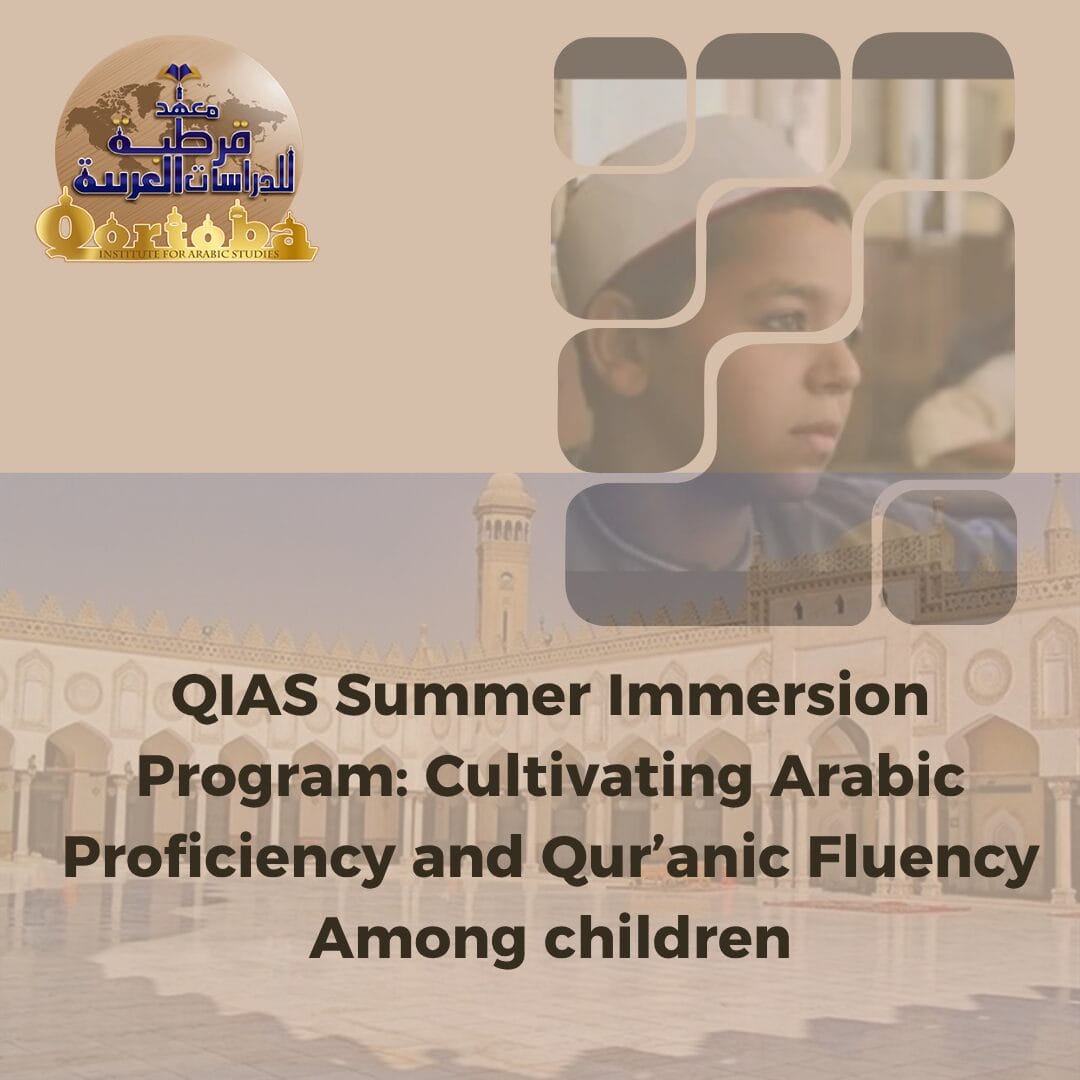
QIAS Summer Immersion Program: Cultivating Arabic Proficiency and Qur’anic Fluency Among children
In a world increasingly characterized by cultural fluidity and the erosion of linguistic heritage, initiatives that anchor young learners in classical languages and sacred texts offer a profound bulwark against intellectual homogenization. QIAS (Qortoba Institution for Arabic Studies) Summer Immersion Program in Egypt stands as one such exemplary model, wherein Arabic language acquisition and Qur’anic studies are not merely taught—they are lived, internalized, and cherished. Designed with meticulous pedagogical care and deep cultural foresight, this program provides an invaluable framework for nurturing linguistic aptitude, moral grounding, and intercultural appreciation among children, particularly those hailing from non-Arabic-speaking regions such as America, Britain, France, Germany and Canada.
- Arabic: A Language of Civilizational Continuity
To comprehend the significance of Arabic is to grasp the essence of an intellectual tradition that spans over fourteen centuries. Far beyond its utilitarian function as a means of communication, Arabic—especially its classical variant, al-fuṣḥā—constitutes a vast repository of philosophical, theological, and literary thought. For children in western communities such as America, Britain, France, Germany and Canada, access to such a linguistic heritage can be both empowering and transformative.
Given, QIAS immersion methodology transcends conventional classroom instruction by embedding children in a fully Arabic-speaking milieu. The pedagogical framework strategically combines foundational grammatical structures (naḥw), morphological derivation (ṣarf), and eloquent expression (balāgha) with interactive conversation and composition. This integrated approach ensures that learners do not simply recognize Arabic as a set of rules, but rather engage with it as a dynamic vessel of meaning, creativity, and expression.
- Qur’anic Instruction: An Intimate Encounter with Revelation
In parallel to its linguistic offerings, the program’s Qur’anic component is both spiritually and intellectually edifying. Through structured modules on memorization (ḥifẓ), phonetic precision (tajwīd), and thematic interpretation (tafsīr), children are gradually inducted into the world of Qur’anic discourse. Unlike rote-driven paradigms, QIAS instructional model foregrounds comprehension, reverence, and ethical resonance.
What distinguishes this process is not merely the acquisition of recitation skills, but the nurturing of a holistic worldview grounded in Qur’anic values—compassion, justice, reflection, and resilience. For families in the West seeking to raise children with firm spiritual morals amidst a secularizing milieu, QIAS provides a sanctuary of sacred learning that bridges intellectual rigor with moral clarity.
- A Living Classroom of Classical and Contemporary Arabic in Egypt
The geographic locus of the program—Egypt—is not incidental but deeply intentional. As home to the venerable Al-Azhar University and a society steeped in Islamic scholarly tradition, Egypt offers an immersive sociolinguistic and cultural ecosystem unparalleled in its authenticity. Children enrolled in the program are thus able to absorb the rhythm and cadence of Arabic not just within classroom walls, but in marketplaces, mosques, and everyday exchanges with native speakers.
Moreover, Egypt’s unique ability to harmonize colloquial accessibility with classical reverence makes it an ideal landscape for young learners. The sights, sounds, and cultural rhythms encountered during excursions and community engagements enhance contextual learning and deepen emotional and cognitive connection to the language and its civilization.
- Methodological Excellence: From Exposure to Mastery
QIAS curriculum is undergirded by a research-informed, age-appropriate progression that balances cognitive development with linguistic challenge. Teachers—many of whom are certified in Qur’anic sciences and Arabic pedagogy—create an environment where encouragement, inquiry, and discipline coalesce. Assessments are adaptive and formative rather than punitive, designed to cultivate confidence alongside competence.
Furthermore, the program’s commitment to small group instruction, individualized feedback, and peer collaboration ensures that non-native speakers children, regardless of their linguistic baseline, are met where they are and progressively elevated. Non-native speakers children can watch QIAS materials for improving listening and speaking skills here:
https://www.youtube.com/@qortobainstitute9918
- Forming Rooted Global Citizens
Beyond language and scripture, the deeper aspiration of the QIAS Summer Program is to foster identity integrity in a pluralistic world. Children return not only equipped with fluency in Arabic and literacy in the Qur’an, but also imbued with a sense of belonging to a legacy far greater than themselves. This grounding fosters humility, intellectual curiosity, and a resilient faith identity—all of which are indispensable tools for navigating the moral and social complexities of contemporary life in Western societies. To see non-native speakers children’s feedback, kindly visit our channel:
https://www.youtube.com/@qortobainstitute9918
In summation, QIAS (Qortoba Institution for Arabic Studies) Summer Immersion Program transcends the functional ambitions of language instruction. It is, in essence, a cultivation of the whole child: intellect, soul, and identity. For non-native speakers families across America, Britain, France, Germany and Canada yearning for a substantive, spiritually anchored, and intellectually rich educational experience for their children, QIAS presents not merely an option—but a rare and invaluable gift.
What to look for in an Arabic immersion course
A good Arabic summer experience links lessons to real communication. Students can practise introductions, directions, shopping and daily routines, and use listening and writing tasks to strengthen the vocabulary learned in class. Teachers may choose activities according to each group's ability. Learners should ask whether Modern Standard Arabic, conversational Arabic, Quran reading or tajweed are part of the selected course rather than assuming every component is always included.
Practical information for a future session
This article describes a historical 2025 edition. Confirm current start dates, teaching hours, fees, accommodation, excursions and level availability on the official Qortoba Summer Program page. The free trial test can support a conversation about placement, while the registration form gives prospective learners a way to enquire. For continued study, explore the general online Arabic course.
An Egyptian house of Arabic learning — teaching Arabic and the Qur'an to non-native speakers online, in Cairo and in Al-Madinah.