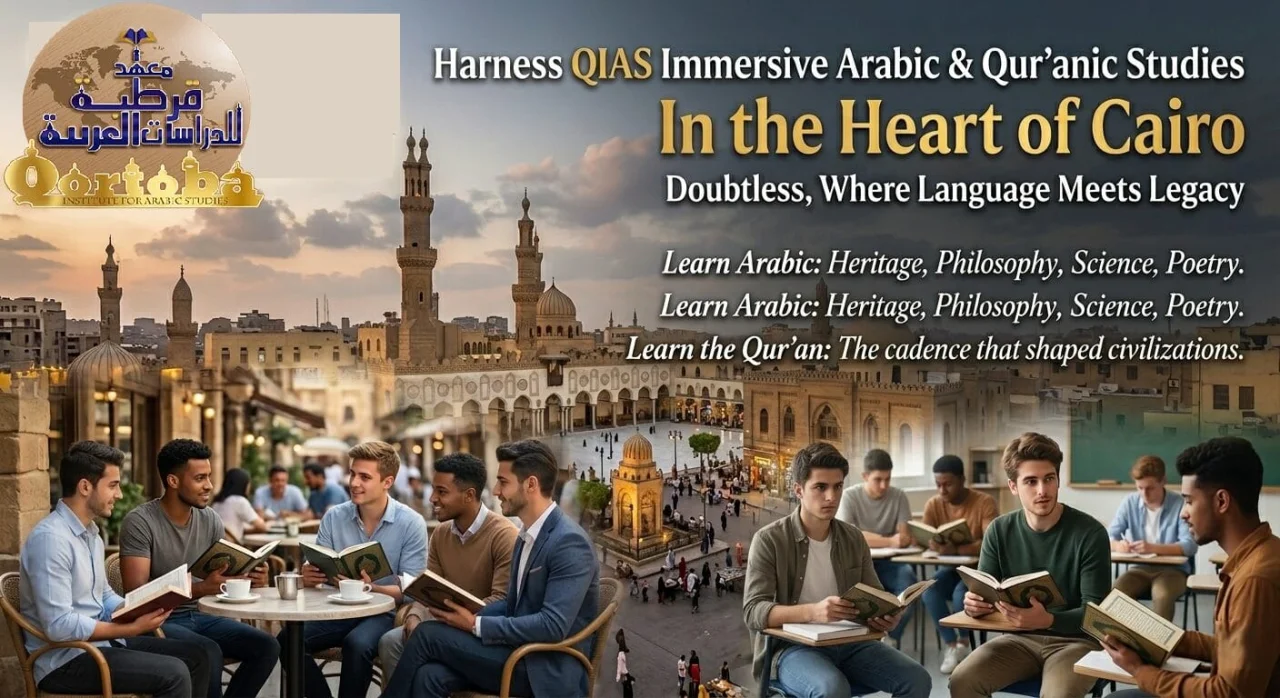
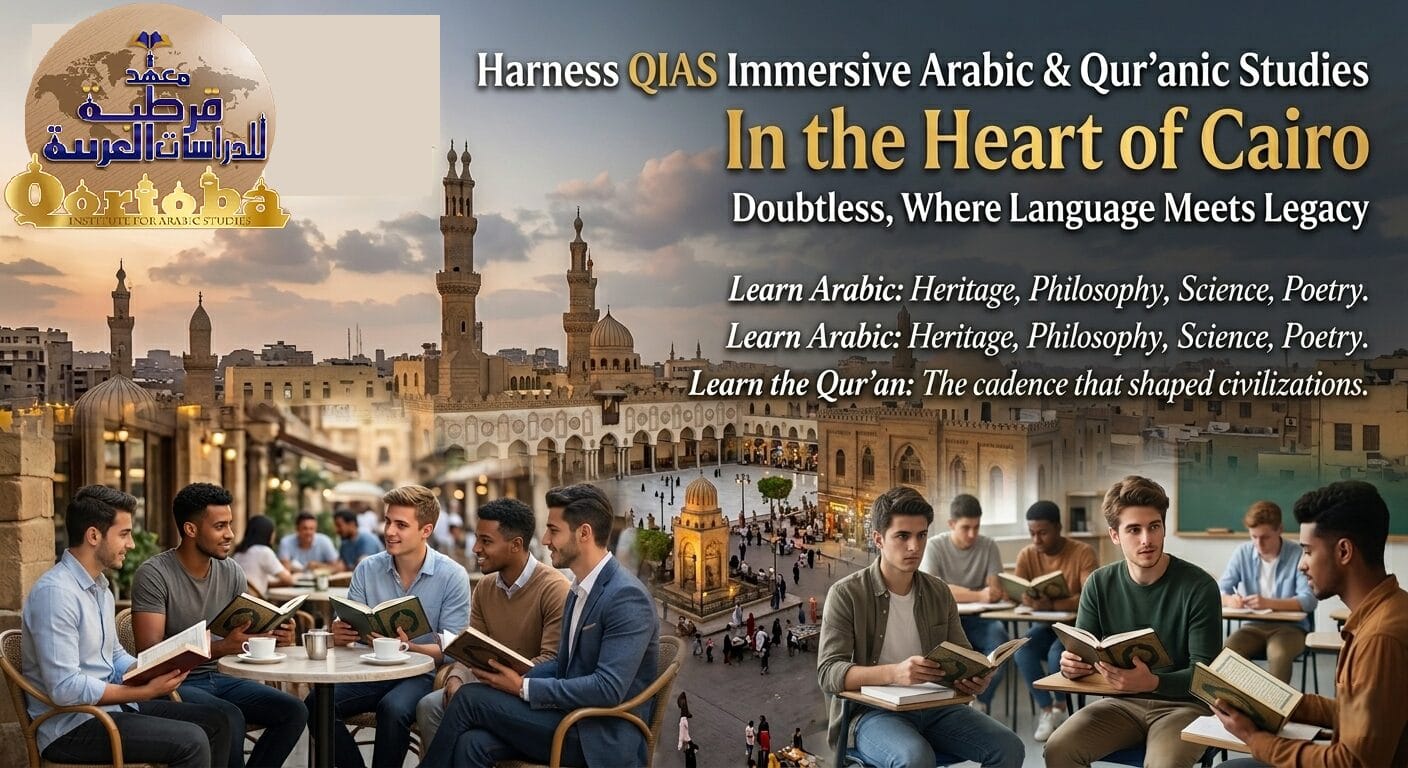
Doubtless, Where Language Meets LegacyTo learn Arabic is to inherit a key to 1,500 years of philosophy, science, poetry, and revelation. To learn the Qur’an is to hear the very cadence that shaped civilizations. QIAS (Qortoba Institution for Arabic Studies), nestled between the thousand-year-old minarets of Al-Azhar and the living pulse of Al-Hussein Square in Cairo, transforms that inheritance into lived experience. QIAS face-to-face courses fuse rigorous scholarship with immersive edutainment, offering non-native speakers—particularly from Spain, Germany, Britain, America, France, and Canada—a path that is as intellectually exacting as it is culturally unforgettable.
At QIAS, the path runs through Cairo’s oldest streets, its most revered mosques, and classrooms where every lesson is both text and context.
- Why Cairo, Why Face-to-Face?
A language lives in the mouths of its people. While apps and online modules have their place, nothing replicates the immediacy of negotiating your way through Khan el-Khalili, hearing Ahlan wa sahlan أهلاً وسهلاً “Welcome” from a bookseller, or catching the call to prayer echo from Al-Azhar’s stone courtyards. Face-to-face study in Cairo offers three irreplaceable advantages:
- Phonetic Precision: Arabic’s emphatic consonants—ṣād ص, ḍād ض, ṭāʾ ط, ẓāʾ ظ—are mastered by ear and imitation. QIAS instructors provide real-time correction, ensuring students from German or English phonetic backgrounds do not flatten qalb قلب “heart” into kalb كلب “dog.”
- Cultural Literacy: You cannot separate fusḥā الفصحى from the Qur’an, nor the Qur’an from the society that recites it. Daily immersion teaches when to say In shā’ Allāh إن شاء الله “God willing” versus Bi’idhnillāh بإذن الله “by God’s permission,” distinctions rarely captured in textbooks.
- Community Accountability: As the English idiom goes, “iron sharpens iron.” In QIAS cohorts, a student from Berlin debates grammar with a peer from Toronto, each keeping the other on their toes.
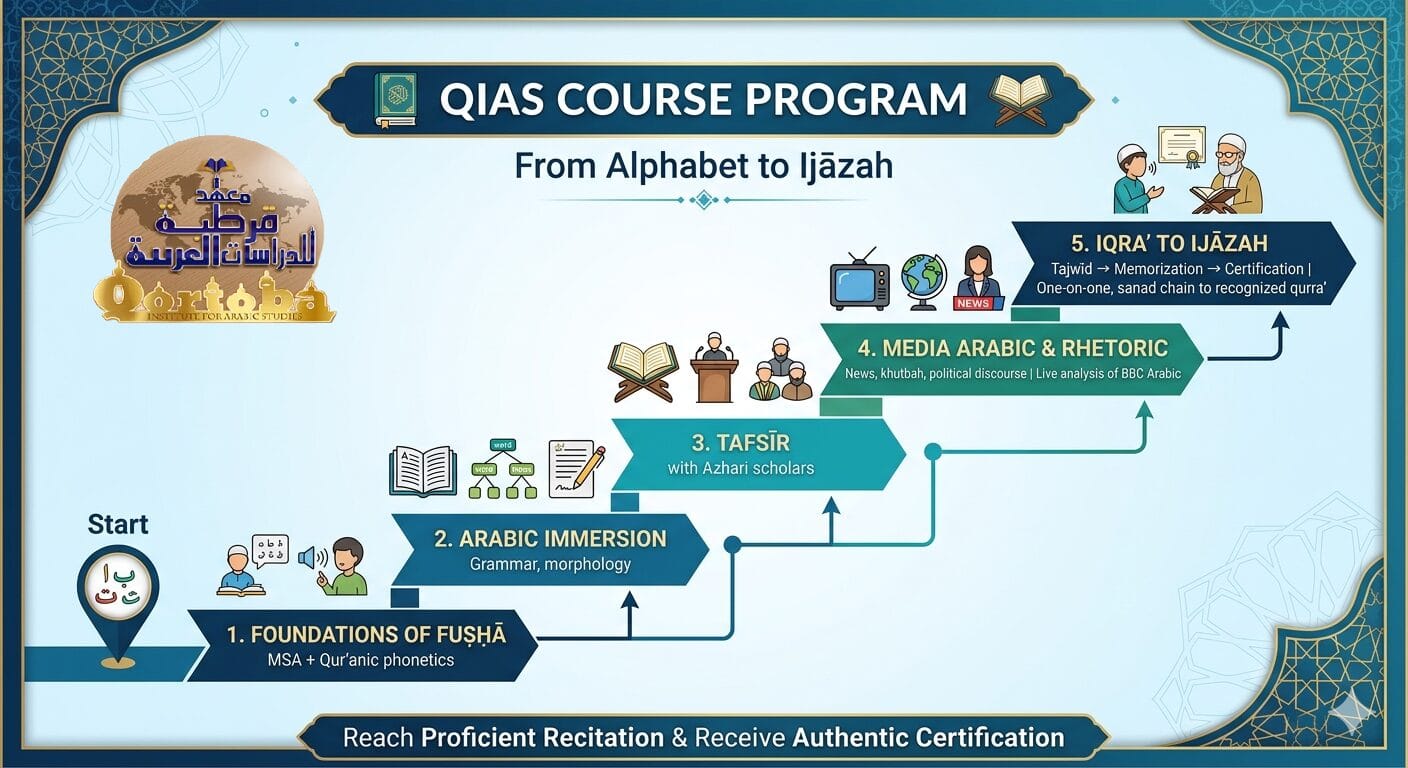
- QIAS Course Program: From Alphabet to Ijāzah
- Foundations of Fusḥā: MSA + Qur’anic phonetics
- Arabic Immersion: Grammar, morphology,
- Tafsīr: with Azhari scholars
- Media Arabic & Rhetoric: News, khutbah, political discourse Live analysis of BBC Arabic
- Iqra’ to Ijāzah: Tajwīd → Memorization → Certification. One-on-one, sanad chain to recognized qurra’
As for example, Foundations of Fusḥā: Grammar—Al-Idāfah الإضافة “The Genitive Construct” through Sūrat Al-Fātiḥah.
- Edutainment—Scavenger hunt in Al-Muizz Street. Students must bargain for kusharī كشري using only kamm? كم؟ “How much?” and ghāli غالي “expensive.”
- Cultural Note—Qur’anic quotation: وَقُل رَّبِّ زِدْنِي عِلْمًا “And say, My Lord, increase me in knowledge.” [Ṭā-Hā 20:114].
- QIAS Immersive Edutainment: Learning by Living
For non-native speaker scholars worldwide such as Spain, Germany, America, Britain, Canada, and France, “Edutainment” at QIAS is not a buzzword. It is pedagogy with a heartbeat.
QIAS Al-Azhar Field Module: Students visit Al-Azhar Mosque, seated where scholars have taught for a millennium. They transcribe a 10-minute segment of the instructor’s lesson, and then reconstruct it in class. This bridges classical rhetoric to modern comprehension.
QIAS Al-Hussein Linguistic Immersion: In the cafés of Al-Hussein, students conduct “Dialogue Diaries.” Task: Order shāy bi-na’nā‘ شاي بالنعناع “mint tea” and ask three locals Mā ra’yuka fī...? ما رأيك في...؟ “What is your opinion on...?” Responses are recorded, transcribed, and analyzed for dialect versus fusḥā.
- QIAS Arabic for Media Courses
QIAS Arabic for Media classes dissect headlines together. Compare: Arabic: “مصر تؤكد التزامها بالسلام الإقليمي”, English “Egypt affirms its commitment to regional peace”.
Arabic media favors nominal sentences and formality; English opts for idiom and verb-driven punch. Non-native speaker students across the globe such as Spain, Germany, America, Britain, Canada, and France learn to wield both.
- Common Phrases Mastered in Context
| Arabic | English Equivalent | Where You’ll Use It |
| As-salāmu ‘alaykum السلام عليكم | “Peace be upon you” | Greeting |
| Jazāk Allāhu khayran جزاك الله خيرًا | “May God reward you with good” | Thanking |
| Lā ba’s لا بأس | “No worries / It’s fine” | Cairo’s answer to “don’t mention it” |
| ‘alā rāsi على راسي | “With pleasure” | Responding to a request in Al-Hussein |
| Bi-ṣarāḥah بصراحة | “Frankly speaking” | Express opinion, Media Arabic for opinion segments |
These are not flashcards. They are the social currency of Cairo, and QIAS non-native speaker students spend them daily.
- QIAS Professionally Designed Courses for Non-Native Speakers
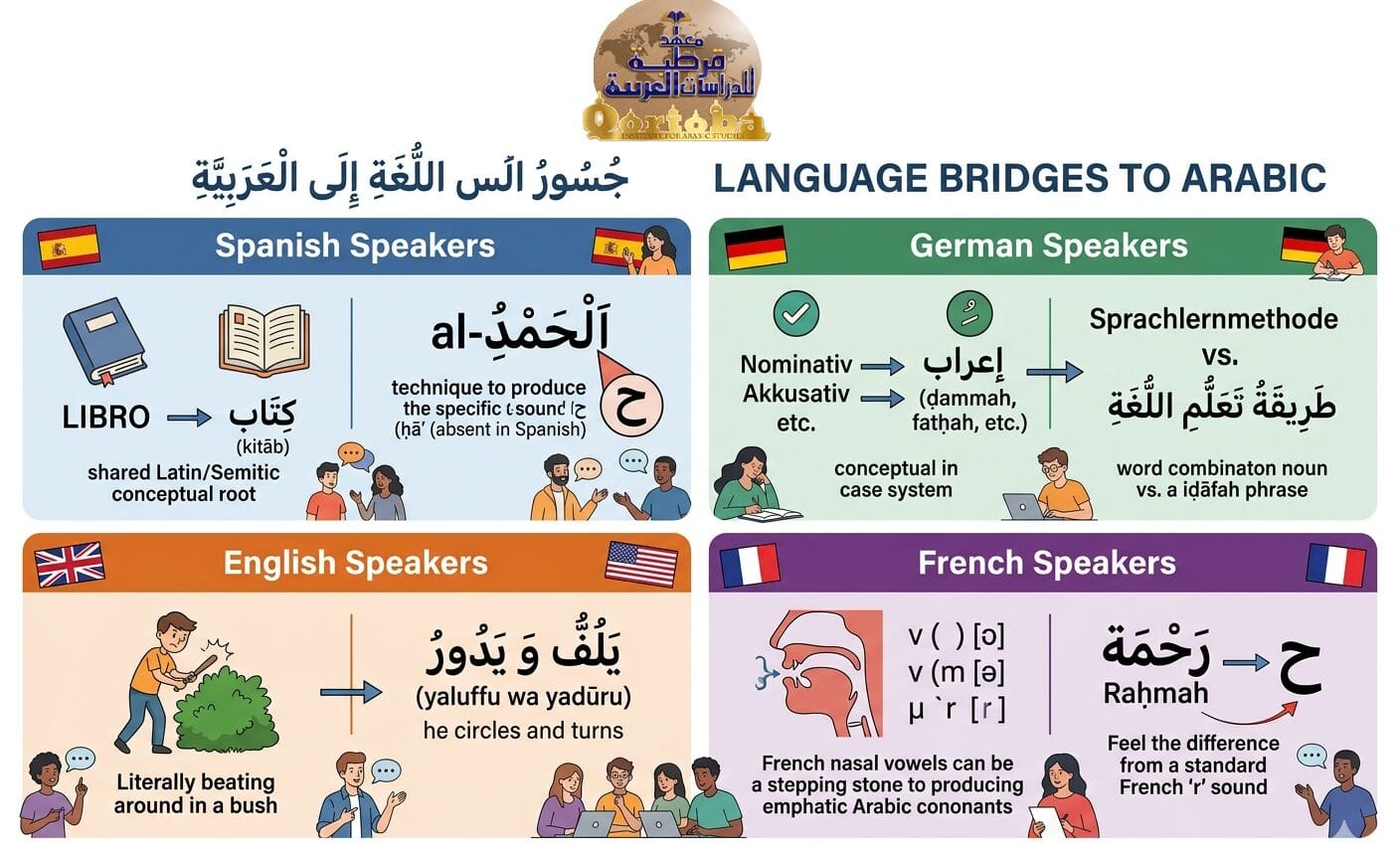
For non-native speaker scholars all over the world such as Spain, Germany, America, Britain, Canada, and France, learning programs are efficiently articulated. Hence, QIAS understands that a lawyer from Madrid wrestles with different language challenges than an engineer from Munich or a poet from Manchester.
- Spanish Speakers: Leverage Romance-language overlap in kitāb كتاب “book” / “libro” through Latin roots. Address the ḥāʾ ح sound, absent in Spanish, via Qur’anic al-ḥamdu الحمد
- German Speakers: Capitalize on case-system familiarity to master Arabic i‘rāb إعراب. Contrast German compound nouns with Arabic iḍāfah.
- English Speakers: Use idiom bridges. “To beat around the bush” becomes yaluffu wa yadūru يلف ويدور “he circles and turns.”
- French Speakers: Address emphatic consonants using French nasal vowels as a stepping stone. Raḥmah رحمة “mercy,” feeling the shift from uvular r to Arabic small cohorts of 6-10 ensures that a Canadian student is never lost in the crowd, and a Berliner never feels the questions are “lost in translation.”
In a nutshell, Al-Azhar’s minaret has called students for 1,000 years. Today, the microphone carries that same call to Madrid, Berlin, London, New York, Paris, and Toronto. QIAS (Qortoba Institution for Arabic Studies) stands at the intersection: one foot in turāth تراث “heritage,” one in tomorrow’s media landscape. To study here is to choose the road less traveled. Your Arabic, your Cairo awaits you. Enroll now for QIAS Summer Edutainment Program 2027. Limited seats, limitless horizons, QIAS – Where the Language Lives.
An Egyptian house of Arabic learning — teaching Arabic and the Qur'an to non-native speakers online, in Cairo and in Al-Madinah.